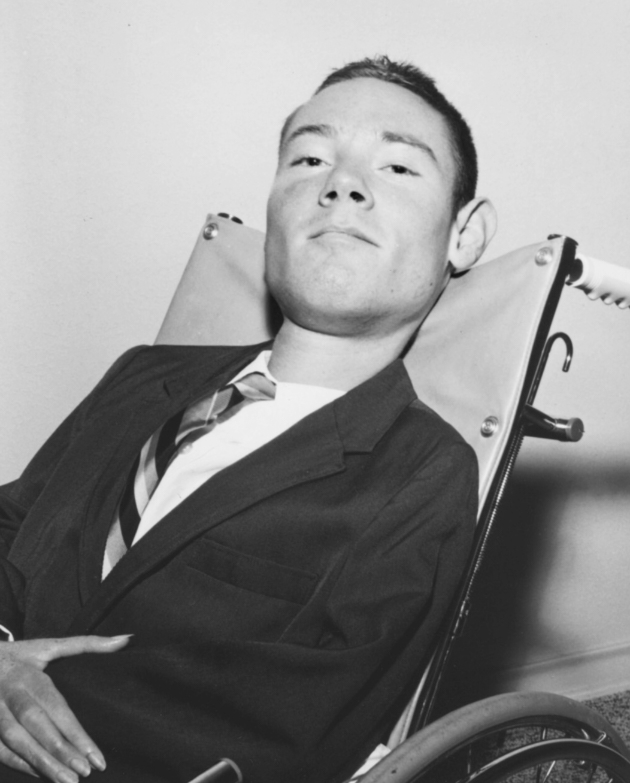
The Crisis: A Childhood Storm
In 1952, at just six years old, Paul Alexander contracted poliomyelitis during one of the most devastating polio outbreaks in the United States. The virus left him paralyzed from the neck down, robbing him of the ability to breathe on his own. His diaphragm no longer functioned, and survival depended on a machine few today have ever seen: the iron lung.
Doctors placed Paul inside the massive metal cylinder, sealing his body inside while leaving his head exposed. The machine rhythmically changed air pressure, forcing his lungs to inhale and exhale. Its mechanical hiss and sigh became his constant companion—his lifeline. He was told he might not survive.
He awoke trapped inside the machine, unable to move, unable to speak. Around him were rows of other children encased in identical respirators. This was the grim reality of polio in its cruelest era—a reality largely forgotten by newer generations.
The Breakthrough: Teaching Himself to Breathe
What followed seemed impossible. Paul refused to surrender his breath entirely to the machine. Through relentless practice, he taught himself a technique he later called “frog breathing”—gulping air into his mouth and forcing it down into his lungs.
A nurse promised him a reward if he could breathe on his own for three minutes. Paul succeeded. His prize was a dog, which he named Ginger.
Though the iron lung never left his life, that moment marked a turning point. Paul learned to stay outside the machine for longer periods—minutes, then hours. He attended classes, interacted with others, and reclaimed pieces of independence most believed he would never have.
The Achievements: A Life Beyond the Machine
Paul refused to let confinement define his destiny. With determination and support, he completed high school and later earned a bachelor’s degree. He went on to law school, passed the bar, and built a career practicing both civil and criminal law in Dallas.
To work and live, Paul adapted. He used an electric-powered wheelchair, assistive technology, and typed using a plastic stick held in his mouth. Helpers assisted with transportation and court appearances, but the intellect, voice, and drive were always his own.
In 2020, he published a memoir titled Three Minutes for a Dog: My Life in an Iron Lung. Later, he embraced social media, becoming a powerful public voice for disability rights, resilience, and polio awareness. In early 2024, he even launched a TikTok account, reaching a new generation with his story.
The Significance: More Than One Man’s Story
Paul Alexander’s life carries meaning far beyond his personal journey.
Medical History:
He was among the last individuals in the world to rely on an iron lung—machines once common but rendered obsolete by vaccines and modern ventilators. His life served as a living reminder of a disease many no longer fear, but should never forget.
Disability and Autonomy:
Paul never viewed himself as trapped. He saw the machine as a tool, not a prison. When asked if his disability felt unfair, he once said he never saw it that way—that he believed he was chosen for the challenge.
Public Health Awareness:
Paul consistently warned that polio’s disappearance was not guaranteed. His story stood as a warning against complacency and a testament to the importance of vaccination.
Legacy of Resilience:
He embraced struggle. He welcomed challenges. Friends described him as a bright light—someone whose courage forced others to confront the limits they placed on themselves.
The Final Chapter: Departure & Remembrance
On March 11, 2024, Paul Alexander passed away at the age of 78 in Dallas, Texas. He had recently been hospitalized after contracting COVID-19, though the precise cause of death was not publicly detailed.
Tributes poured in from around the world. Those who knew him did not speak of pity or limitation, but of optimism, ambition, and unwavering will. One friend reflected that Paul could do anything in spirit, while the rest of us often confine ourselves with imagined barriers.
Why “The Breath Between the Bars”?
The title is both literal and symbolic.
Bars represent the iron lung itself—the metal enclosure, the visible barrier between Paul and unassisted breath—as well as the societal walls often placed around disability.
Breath is life’s most basic rhythm. Though mechanically assisted for decades, Paul fought to reclaim autonomy over it whenever possible.
Between reflects the space Paul inhabited—not fully free of the machine, yet never defined by it. A life lived between dependence and achievement, confinement and expansion.
Key Takeaways
- The human spirit can transcend extraordinary odds.
- Disability is not inability.
- History matters, especially when its lessons fade too easily.
- Purpose can grow from limitation.
- Legacies endure beyond machines and bodies.
Final Reflections
When we remember Paul Alexander, we must resist focusing only on the iron lung or the paralysis. Instead, we remember the man who filled that machine with ambition, humor, advocacy, and life.
He did not ask, “Why me?”
He asked, “Why not me?”
He was a lawyer, an author, a creator, a friend, and a voice for those often unheard.
Paul once said he didn’t know anyone else who breathed the way he did—and that it kept him alive. Perhaps the deeper truth is this: the machine sustained his body, but his spirit gave him life.
In honoring him, we honor courage over confinement, purpose over limitation, and breath over bars.
Rest in peace, Paul Alexander.
Your breath between the bars will echo for generations.