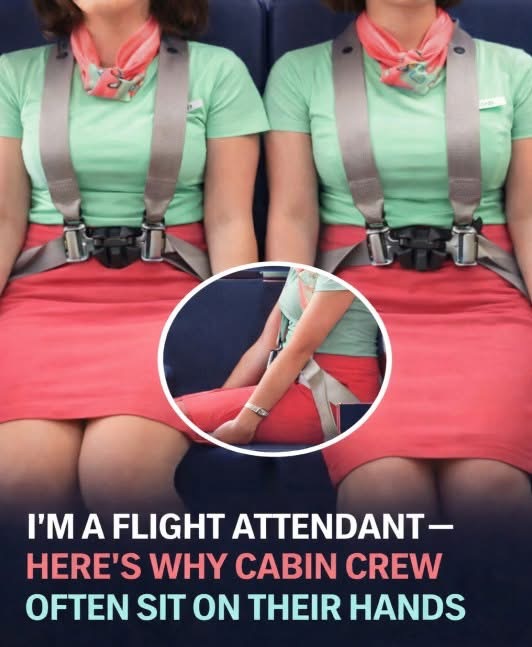
If you’ve ever glanced toward a flight attendant during takeoff or landing and noticed them sitting upright with their hands tucked neatly beneath their thighs, you may have assumed it was a comfort habit or simple routine. In reality, that posture is neither casual nor optional. It is a deliberately trained safety position, developed through decades of aviation research, crash investigations, and survival psychology — and it has one clear purpose: to save lives.
The Most Dangerous Minutes in Aviation
Statistically, the majority of aviation incidents occur during takeoff and landing. These phases involve rapid changes in speed, altitude, and mechanical stress on the aircraft. Even with modern technology, these moments carry the highest risk of sudden turbulence, aborted takeoffs, hard landings, or emergency evacuations.
Because of this, flight attendants shift from hospitality mode into emergency readiness mode. Their role during these minutes is not to serve passengers, but to act as the aircraft’s first responders.
The Brace Position You Don’t Notice
The posture you see — sitting fully upright, feet flat on the floor, back straight, chin level, hands palms-up under the thighs — is known as a crew brace position.
This position serves several critical functions:
- Body stability: By locking the arms in place, the body becomes more rigid and controlled, reducing the risk of flailing limbs during sudden impact.
- Injury reduction: Arms and hands are especially vulnerable in crashes. Securing them helps prevent fractures or dislocations.
- Spinal alignment: An upright posture helps protect the spine and neck from whiplash injuries.
- Muscle readiness: The position engages core muscles, allowing faster movement immediately after impact.
In emergencies, seconds matter. A flight attendant who avoids injury can open exits, guide passengers, extinguish fires, and provide life-saving instructions.
Why Hands Under the Thighs?
This detail often draws the most curiosity. Placing hands palms-up beneath the thighs may look strange, but it’s intentional:
- It prevents instinctive reactions, such as reaching out or bracing incorrectly.
- It anchors the arms, limiting uncontrolled motion during impact.
- It keeps the hands protected and close to the body, reducing injury.
In high-stress situations, the human body defaults to reflex. Training overrides reflex with discipline.
Mental Readiness Is Just as Important
This posture isn’t only about physical protection — it’s also psychological.
During takeoff and landing, flight attendants are trained to:
- Silently rehearse emergency commands
- Scan the cabin for potential hazards
- Listen for abnormal sounds or vibrations
- Monitor passengers who may need assistance
This mental focus is known in aviation psychology as “situational awareness under stress.” The posture reinforces alertness and readiness, helping crew members transition instantly from observation to action.
Why Passengers Brace Differently
You may have noticed that passenger brace positions are different — often leaning forward with hands protecting the head. That’s because passengers are not expected to assist others. Their priority is self-protection.
Flight attendants, however, must:
- Remain mobile
- Stay conscious
- Be able to stand quickly
- Help evacuate dozens (or hundreds) of people
Their brace position balances protection with mobility.
A Position Written in Experience
This practice wasn’t created arbitrarily. It is based on real-world accident investigations, survival data, and biomechanical research. Aviation safety evolves by learning from what went wrong — and what helped people survive.
Every time a flight attendant sits this way, they are silently preparing for a scenario everyone hopes will never happen.
So Next Time You See It…
Remember:
That stillness is not boredom.
That posture is not habit.
It is training, discipline, and responsibility in action.
While passengers relax, the crew prepares. And that quiet preparation has saved countless lives — often without anyone ever realizing it.