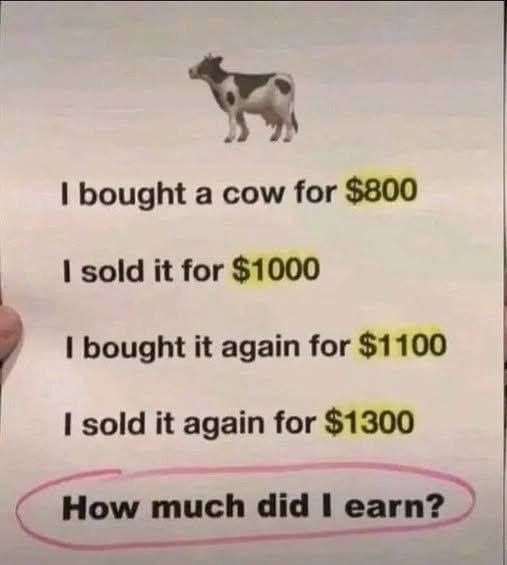
This simple cow puzzle looks easy at first, but it confuses many people because the cow is bought and sold twice. The first transaction starts when the cow is bought for $800 and sold for $1000. That means the first profit is $200, because $1000 minus $800 equals $200.
Then the cow is bought again for $1100. Some people think this cancels out the first profit, but it does not. It is simply a new transaction. After buying it again for $1100, it is sold for $1300. That creates another profit of $200.
Now the two profits must be added together. The first profit was $200, and the second profit was also $200. When you add them, the total profit becomes $400.
So the correct answer is not $100, $300, or $500. The person earned money twice, once from each sale. Each time, they bought low and sold higher.
The final answer is $400. That is why the puzzle tricks people: they focus on the full buying and selling prices instead of simply calculating the profit from each round.