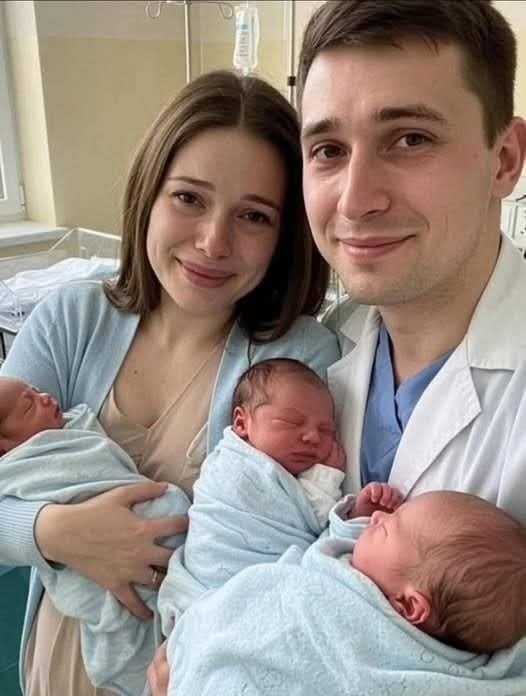
A pregnancy involving triplets represents one of the most complex and demanding forms of human gestation. It stands as both a striking demonstration of the female body’s ability to support multiple developing lives at once and a reminder of the heightened medical vigilance such a condition requires. In clinical practice, multiple pregnancies are consistently categorized as high risk, not because complications are guaranteed, but because the probability of physiological strain and obstetric challenges rises significantly compared to singleton pregnancies. Modern obstetric care has made considerable progress in monitoring and managing these cases, yet the biological realities remain unchanged: carrying more than one fetus simultaneously places extraordinary demands on nearly every system in the body.
When a woman carries triplets, her cardiovascular system is required to work at an intensified level. Blood volume increases substantially during pregnancy in general, but in multiple gestations this expansion is even more pronounced. The heart must pump harder and more frequently to supply oxygen and nutrients not just to one developing fetus, but to three. At the same time, the kidneys are placed under additional pressure as they filter increased metabolic waste for both mother and babies. The uterus itself expands beyond typical limits, stretching in ways that can intensify discomfort and raise the likelihood of premature contractions or other complications.
Because of these physiological demands, medical professionals remain especially attentive to conditions such as gestational hypertension and preeclampsia, both of which are more commonly observed in multiple pregnancies. These conditions involve dangerous elevations in blood pressure and, if left unmanaged, can affect both maternal and fetal health. Additionally, the risk of postpartum hemorrhage is higher following the delivery of multiples, due in part to uterine overdistension and the body’s increased recovery burden after birth. Each of these risks underscores the importance of close monitoring throughout pregnancy and the postpartum period.
For the young mother at the center of this story, her pregnancy became a prolonged period of endurance, uncertainty, and determination. Each day carried a mixture of physical discomfort and emotional weight, as she navigated the knowledge that her body was supporting three developing lives under inherently risky conditions. The experience was not simply medical; it was deeply personal and emotional, shaped by anticipation, concern, and unwavering focus on the wellbeing of her unborn children.
Throughout this time, she persisted through exhaustion and pain with remarkable resolve. The emotional landscape of her journey could be described as a continuous state of alertness, where hope and fear existed side by side. Her attention remained anchored to a singular priority: the survival and health of her babies. Even as her body signaled fatigue, she continued forward, sustained by the belief that endurance in the present moment would shape the future lives she was preparing to bring into the world.
When the time for delivery finally arrived, the atmosphere in the medical setting reflected both urgency and cautious optimism. A team of healthcare professionals worked with coordinated precision, aware of the heightened risks but prepared with the best available interventions. The moment the children were born, a palpable sense of relief filled the room. What had been a long and uncertain journey transitioned, in an instant, into the presence of new life.
Those who witnessed the birth later recalled the emotional shift in the mother’s expression. Despite profound physical exhaustion, there was a visible change in her demeanor when she first saw her children. It was as though, in that moment, something within her overcame the strain she had endured. Her reaction was not focused on herself but entirely directed toward the infants. She immediately sought reassurance about their condition, repeatedly asking if they were safe and healthy, as though trying to confirm that the long-awaited outcome was real and not fragile or temporary.
In the hours that followed delivery, the family and medical staff witnessed moments that would later take on deep emotional significance. Simple gestures—her attempting to smile, her reaching out to touch each newborn, her quiet observation of their faces—became lasting memories preserved through photographs and video recordings. These early interactions captured the essence of a mother meeting her children for the first time, still caught between exhaustion and overwhelming emotion.
In those recordings, her expression conveyed a mixture of relief, awe, and disbelief. She gently traced the outlines of each infant’s features, as though grounding herself in their physical presence. There was a sense that she was already imagining their futures: first steps, childhood milestones, and the passage of time she hoped to witness. At the same time, there was an unspoken awareness of how fragile early life can be, especially under medically complex circumstances. These captured moments would later become deeply treasured by her family, preserved not just as memories but as enduring representations of her love and presence.
However, within a short time after delivery, the situation shifted unexpectedly. The early postpartum period, which is already medically sensitive for any mother, became critical. Vital signs that had previously been stable began to show concerning changes. Medical teams responded quickly, recognizing that postpartum complications can escalate rapidly, particularly after high-risk pregnancies involving multiple births. Despite the presence of advanced medical technology and the immediate attention of skilled professionals, the condition progressed with alarming speed.
The transition from joy to crisis unfolded in a brief and devastating window of time. What had begun as a moment of celebration and relief turned into an urgent medical emergency. Despite continuous intervention and intensive care efforts, the underlying complications proved too severe to reverse. The abruptness of this shift created a profound emotional rupture for the family and care team alike.
Such rapid transitions from birth to critical condition and eventual loss create a form of emotional trauma that is difficult to process. The human mind struggles to reconcile the presence of new life with the sudden absence of the person who brought that life into existence. This kind of psychological shock is often described as a collision of extremes—joy and grief occupying the same timeline, separated only by moments rather than days or weeks.
In the aftermath, the family was left to navigate an altered reality. The children remained, healthy and newly born, while the mother’s presence shifted from physical reality to memory. The contrast between beginnings and endings became the defining emotional landscape of their lives from that point forward.
As time passed, the responsibility of preserving her legacy naturally shifted to those closest to her. Relatives and loved ones became the custodians of her memory, tasked with ensuring that her story would remain alive for the children as they grew. Because the triplets would not have personal memories of their mother, their understanding of her would be formed entirely through narratives, photographs, and recorded moments. In essence, her identity would be transmitted through stories rather than lived experience.
These stories would emphasize her strength, her determination, and the depth of her care for her children. She would be described not only as a mother but as someone who faced extraordinary medical risk with resolve and courage. Over time, her presence would become woven into the family’s daily life in subtle but persistent ways. Her voice, captured in recordings, would become familiar. Her expressions in photographs would become part of the household’s emotional fabric. In this way, memory would take on a living form, even in her absence.
The children themselves would grow up carrying physical and behavioral traces of their mother. Family members would often notice similarities—shared facial expressions, gestures, or temperamental traits—that served as reminders of her presence in their lives. These similarities would offer comfort, reinforcing the idea that aspects of her continue through them in tangible ways.
Within the family, this continuity would become a source of emotional grounding. The children would be seen not only as individuals but also as living connections to the person who brought them into the world. Their development, achievements, and daily lives would carry added emotional significance, as each milestone would represent both their own growth and a continuation of her legacy.
From a broader societal perspective, cases like this highlight the importance of specialized maternal healthcare, particularly during the postpartum period. Medical outcomes in multiple pregnancies have improved significantly over time, yet they continue to require intensive monitoring due to the inherent physiological strain involved. The postpartum window, in particular, is recognized as a critical phase in which complications can arise unexpectedly and progress rapidly.
Healthcare systems around the world continue to refine protocols aimed at reducing maternal risk during and after delivery. This includes early detection of complications, rapid response systems, and increased awareness of warning signs during postpartum recovery. Despite these advances, cases involving severe and sudden outcomes underscore that medicine still operates within limits defined by human biology.
Beyond the clinical implications, stories like this also draw attention to the often-unseen emotional and psychological dimensions of childbirth. The experience of bringing new life into the world is frequently accompanied by significant physical risk and emotional intensity. In high-risk pregnancies, these elements become even more pronounced, as families navigate uncertainty alongside hope.
Ultimately, the story of this young mother and her triplets reflects a deeply human intersection of life, risk, and love. It illustrates how profoundly interconnected joy and vulnerability can be in moments of childbirth. Her journey, though marked by tragedy, also represents profound devotion—a willingness to endure extraordinary physical demands for the sake of her children.
Her legacy continues not through the length of her life, but through the lives she enabled. The children she brought into the world stand as a continuation of her story, carrying forward the beginning she made possible. For those who knew her, her memory remains present in everyday moments, preserved through narrative, image, and resemblance.
In the years ahead, the children will come to understand their mother through the fragments left behind: stories told by family, recorded glimpses of her voice and smile, and the recurring reflections of her character seen within themselves. Through these elements, her presence will persist—not as a distant or fading memory, but as an ongoing influence shaping their sense of identity and belonging.
In this way, the conclusion of her life becomes inseparable from the beginning of theirs. One story ends as three others begin, linked together by a single moment of profound transition.