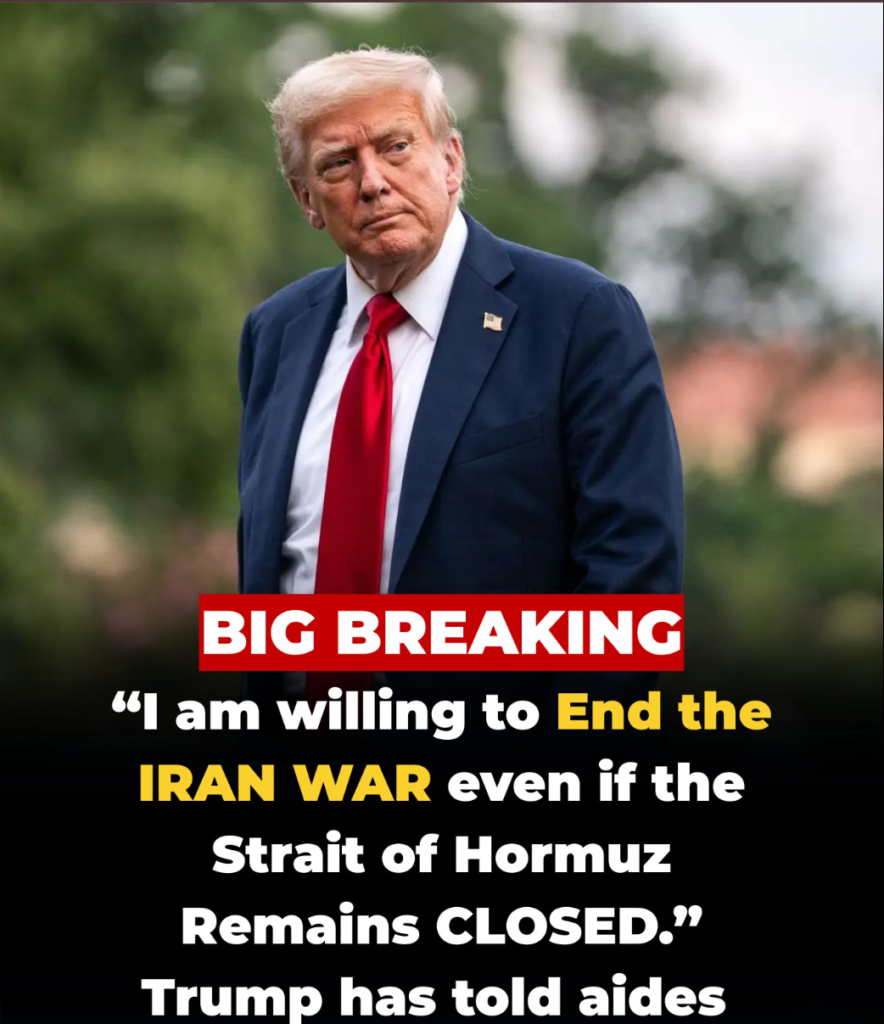
report cited by Reuters, Donald Trump has told aides he is prepared to bring the war with Iran to an end even if the Strait of Hormuz remains closed or only partially reopened. Reuters noted it could not independently verify the report. Still, if accurate, this would represent a major strategic and political shift in how the conflict is being framed.
The Strait of Hormuz is not a secondary issue. It is one of the most critical maritime chokepoints in the world, carrying a huge share of global seaborne oil trade. For years, the logic behind any major confrontation in the Gulf has been tied not only to military goals, but also to keeping this passage open because disruptions there immediately affect shipping, energy prices, inflation, investor confidence, and the broader global economy. That is why the idea of ending a war while leaving Hormuz unresolved feels so consequential.
What makes this moment especially striking is the contradiction at its core. If a war contributes to destabilizing the very corridor that global markets depend on, then declaring victory without restoring that corridor risks looking less like resolution and more like strategic exhaustion. It suggests the priority may no longer be full stabilization, but rather securing a politically acceptable off-ramp. In other words, the mission may be shifting from “fix the region” to “end the costs.” This is not a small distinction. It changes how allies, rivals, markets, and voters interpret the purpose of the conflict. The White House has also signaled that fully reopening Hormuz is not being treated as one of the core objectives of the operation.
That also raises a deeper question: what exactly counts as success? If Iran’s military capabilities are degraded but the world’s most important energy artery remains impaired, can that really be called a stable outcome? Washington appears to be signaling that it may accept a scenario in which the military phase winds down first and the Hormuz problem is pushed into later diplomacy, allied coordination, or a future maritime security effort. That may be pragmatic in the short term, but it leaves behind a dangerous grey zone where the fighting slows while the economic aftershocks continue.
The market reaction alone shows why this matters. Reports of possible de-escalation lifted sentiment in stocks, but oil remained volatile, and analysts continued to focus on how unresolved disruption in Hormuz could keep pressure on energy prices and global trade. So even if the political headline becomes “war may end soon,” the economic story may be very different. A ceasefire without restored maritime normalcy is not full peace. It is a pause under pressure.
In that sense, the real issue is bigger than Trump, Iran, or one headline. It is about whether modern wars are now being managed around optics and political limits rather than around complete strategic outcomes. If the goal is no longer to secure the chokepoint before ending the conflict, then the world is being asked to accept a new standard: that a war can be considered “over” even while one of its most damaging consequences remains unresolved. That is not just a policy shift. It is a redefinition of what ending a war actually means.